
Project Collaborators

I first read the Odes of Solomon in my youth while on my back looking up at the slowly shifting clouds of the California Mojave Desert. The soft spirit of the wind surrounded me and the warm sand supported me while Joshua trees and primeval creosote bushes flanked me, bushes already long ancient when the anonymous Solomonic odist walked the earth. My first impression, which has since only been strengthened, was that the odist’s personal spiritual identity was shaped above all by a profound love for the Jewish Torah, to which he constantly alludes by deploying a rich variety of its standard (but often startlingly applied) poetic synonyms from literature of the Second Temple era. It is this aspect of the Odes of Solomon that has held my interest over the decades since that day in the Mojave Desert. My youth is now gone, and the world that existed then is gone, but it all lives on in my heart. Translating the Odes of Solomon was a welcome act of nostalgia, and it would not have been possible without Mark Mattison’s encouragement and helpful feedback on my translation’s various drafts, for which I am grateful. I also thank Charles Häberl and Bernhard Lang for their helpful comments on the manuscript and for their kind endorsements.
I was song, and God the rhyme . . .
Rainer Maria Rilke, Book of Hours I:50
Samuel Zinner
ORCID ID: 0000-0001-8971-2490
26 October 2020

Photograph by Leah Frey
I first encountered the Odes of Solomon as a young man in Bible college, but it wasn’t until a passion for mystical Christianity was enkindled in me decades later that this text took on a whole new meaning. I was captivated by this rare glimpse into the spiritual ferment of Jesus’ followers before Christianity became a distinct world religion – a liminal faithfulness that can be expressed only in the language of poetry, not dogma. The idea of translating the Odes appealed to me, but I quickly dismissed the thought since I could only work with the Coptic and Greek texts. Years later, when Samuel Zinner proposed to translate the Syriac Odes if I would translate the Coptic and Greek, I couldn’t refuse. It’s both a pleasure and an honor to work with someone of such vast knowledge and exceptional philological skills. I’ve enjoyed our many hours of poring over the digital photographs of the Greek manuscript and puzzling over its unique features. I’m also grateful to Lance Jenott, who graciously gave of his time in reviewing my work on the Coptic. Of course, I remain solely responsible for any errors in my work.
Mark M. Mattison
ORCID ID: 0000-0002-4645-8653
26 October 2020
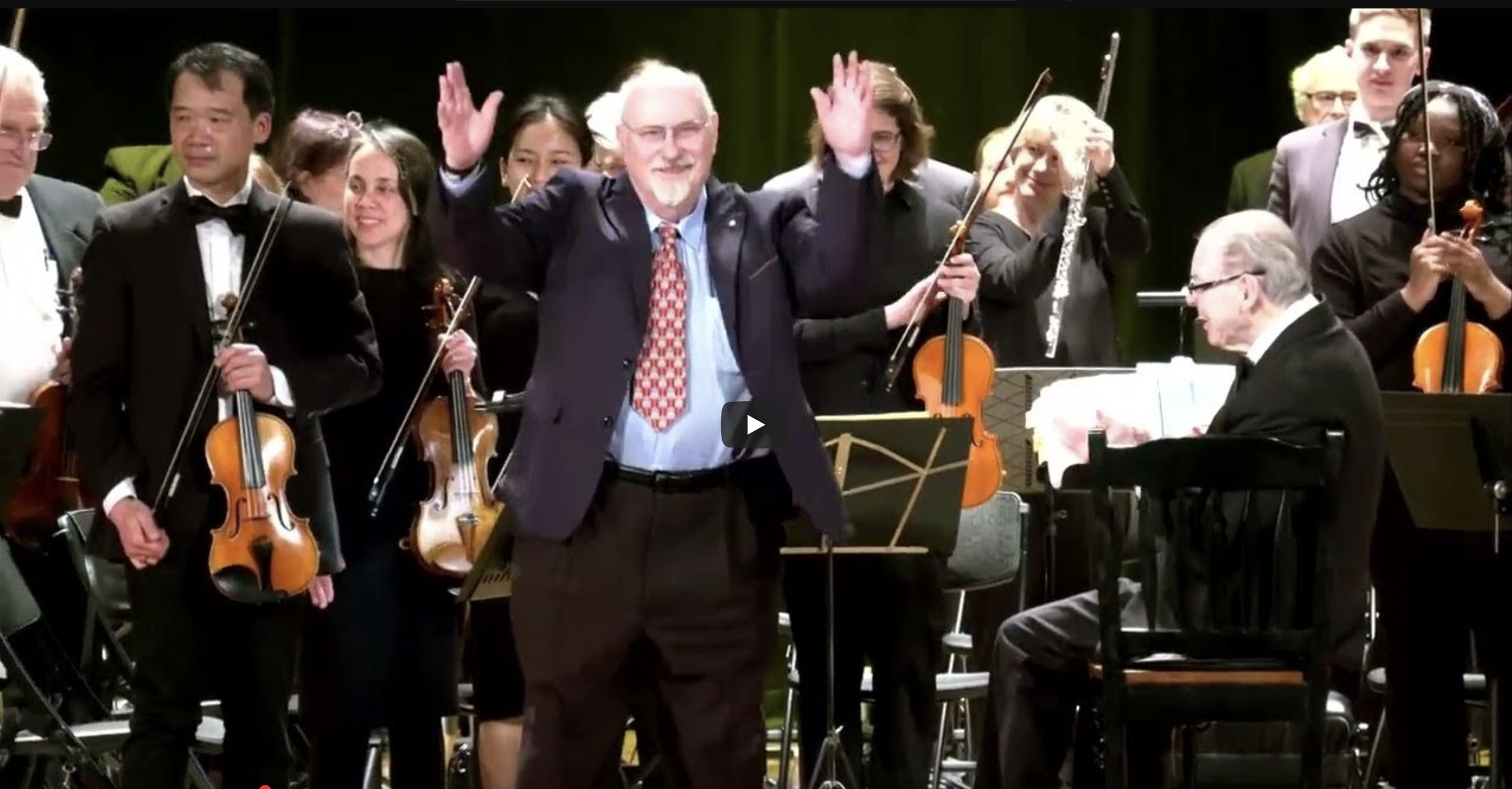
Richard St. Clair at a recent orchestra premiere.
The “Odes of Solomon” are for me a recent discovery to my great delight, and it immediately appealed to my composer instincts as conducive to setting for singers and organ. In addition, they resonated profoundly with my own Christian faith. The music I have written thus far draws from four odes. To avoid any ambiguity about authorship (not by Solomon!), I have renamed the cycle "The Apostolic Odes" in honor of their proximity to the Apostolic Age. I will submit them as they become ready to upload.
As far as my own experience composing choral and organ music, my first composition, “In Thy Name” (now lost) I wrote in 1963, and later that year I wrote my first choral piece, “Lamb of God.” Over the half-century since, I have composed a substantial catalogue of music for worship and reflection. For example, I have composed over 500 chorale-hymns, including a complete Psalter for chorus, and several motets. I have to think far back to my studies at Harvard in my bachelor’s degree, finishing up my PhD in 1978.
My choral works are slowly starting to make their way beyond the borders of the US. I’ve also written a lot of secular music. My oeuvre contains 3 full symphonies, 3 piano concerti, 5 string quartets, 5 Masses, 15 solo piano sonatas, and two volumes of accompanied songs. I am listed in “Who’s Who in America” and Wikipedia, and much of my music is available for sale in hardcopy and digital formats.
Richard St. Clair
March 2, 2026